 Mind Your Body Podcast
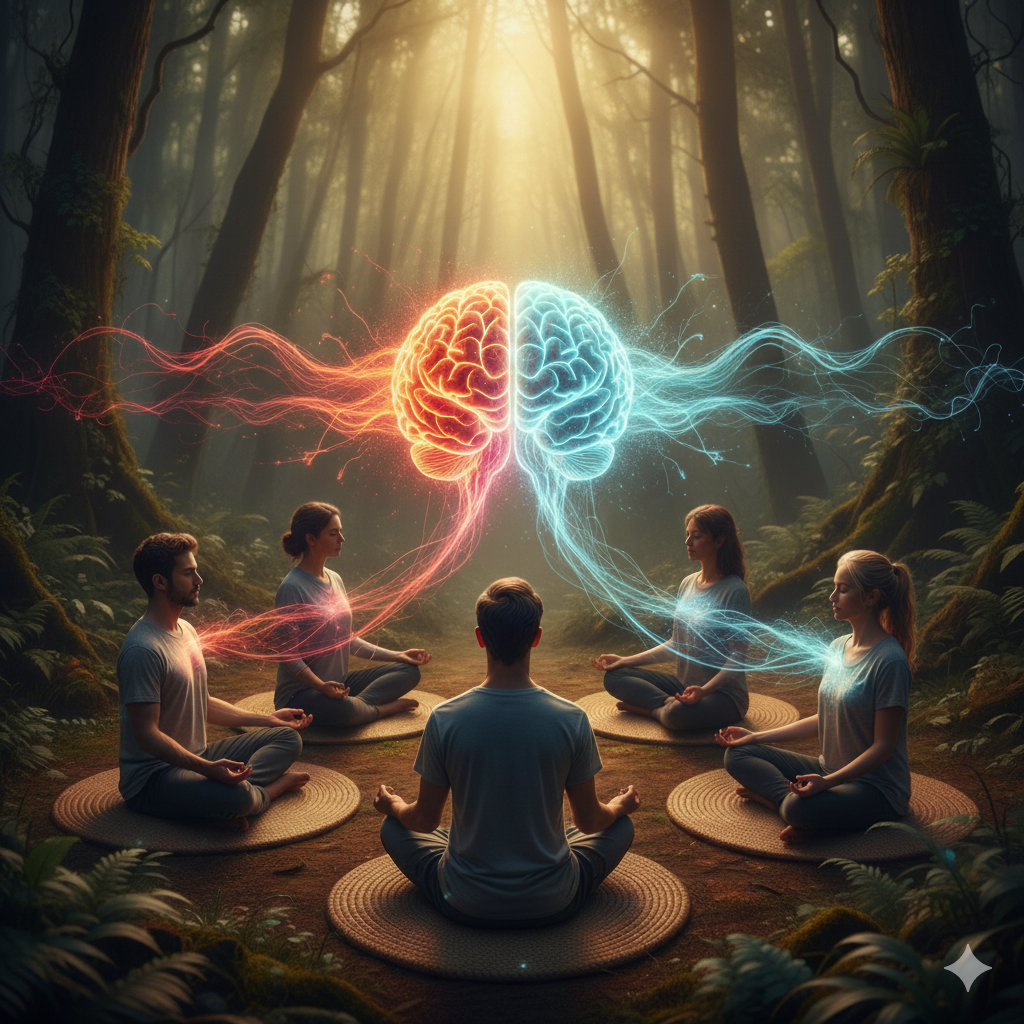
Inspiration: Episode 2: Out of Our Minds of the Mind Your Body podcast with Dr. Nevo.
I spend my days helping people whose bodies have become strangers to them. They arrive in my office carrying pain like a heavy coat they can’t take off, convinced something is fundamentally broken. What I’ve learned through years of integrative pain medicine is this: the path to healing often runs through the mind, not around it.
Mindfulness has become a buzzword in wellness circles, thrown around so casually it’s lost much of its meaning. But when properly understood and applied, mindfulness represents one of the most powerful tools we have for transforming our relationship with pain, stress, and our own bodies.
Let me show you what I mean.
The Brain That Learns Pain Can Unlearn It
Here’s something that changes everything: your brain constructs your pain experience from sensory signals, context, and past experiences. It’s not simply receiving pain—it’s actively creating it based on what it perceives as threatening.
This is neuroplasticity in action, and it cuts both ways.
The same brain that learned to amplify danger signals can learn to recalibrate them. Research from Massachusetts General Hospital shows that just eight weeks of mindfulness practice measurably changes brain structure and improves emotional responses.[1] The brain physically reorganizes itself.
I’ve watched this transformation happen in my patients. The woman who couldn’t sit through a meal without back spasms. The athlete whose shoulder pain ended his career. The executive whose migraines controlled her schedule. When they learned to observe their sensations without immediately labeling them as threats, something shifted.
Their pain didn’t always disappear overnight. But their relationship with it changed. And that changed everything.
What Mindfulness Actually Does
Mindfulness is present-moment awareness without judgment. That’s the textbook definition, but here’s what it means in practice:
Your brain operates like a prediction machine, constantly scanning for threats and making split-second decisions about what sensations mean. When you have chronic pain, this system becomes oversensitive. A twinge becomes a crisis. Discomfort becomes danger.
Mindfulness interrupts this automatic threat interpretation.
Think of it this way: your nervous system is conducting a constant conversation between your body and brain. Most of the time, you’re not consciously listening to this dialogue—you’re just reacting to it. Mindfulness teaches you to actually hear the conversation instead of just responding to the loudest voice.
A November 2024 systematic review confirmed what we’ve been seeing clinically: mindfulness induces neuroplasticity, increases cortical thickness, reduces amygdala reactivity, and improves brain connectivity.[2] These aren’t just feel-good changes. They’re measurable alterations in how your brain processes information and regulates emotion.
The Science Behind the Shift
The evidence for mindfulness keeps getting stronger, and it’s worth understanding why it works.
Pain Management: Mindfulness meditation is significantly superior to placebo treatments in reducing both pain intensity and unpleasantness.[3] This matters because it demonstrates mindfulness works through unique mechanisms, not just expectation. The research shows it changes activity in brain areas important for pain perception and emotional processing—specifically the orbitofrontal cortex and anterior cingulate cortex.
Stress Reduction at Scale: In one of the largest randomized controlled trials on mindfulness, researchers studied 2,239 participants across 37 sites. Four mindfulness exercises significantly reduced short-term, self-reported stress.[4] The study also revealed something practical: self-administered mindfulness exercises work without an instructor present, making the practice accessible to everyone.
Workplace Impact: Meta-analysis results show mindfulness programs reduce perceived stress (effect size = -0.66), subsyndromal symptoms (effect size = -0.48), and burnout (effect size = -0.37) in workplace settings.[5] Researchers calculated potential company savings of up to $22,000 per employee based on reductions in burnout and subsequent increases in workforce productivity.
Rapid Brain Changes: Just five weeks of mindfulness practice can reduce impulsivity and create lasting brain changes.[6] In one study, risky drivers described feeling less urgency and reactivity after five weeks. Their brain scans showed measurable changes—the size of the right caudate nucleus became smaller.
Long-Term Positivity: Mindfulness training produces a sustained, long-term shift toward positivity.[7] Research from 2022 demonstrates that mindfulness doesn’t just reduce negative states—it fundamentally recalibrates how we interpret emotional ambiguity, creating lasting optimism.
The Mind-Body Connection You Can’t Ignore
Your nervous system doesn’t distinguish between physical and emotional threats. A looming deadline triggers the same stress response as a physical danger. Chronic stress keeps your nervous system in a state of high alert, amplifying pain signals and making healing harder.
This is where mindfulness becomes essential.
Your autonomic nervous system regulates everything from heart rate to digestion to pain perception. When you’re stuck in sympathetic overdrive—the fight-or-flight state—your body prioritizes survival over healing. Mindfulness helps shift you into parasympathetic activation, where healing actually happens.
Research shows that seven weeks of coherence training improves vagal tone, a key marker of nervous system flexibility.[8] Better vagal tone means better stress resilience, improved emotional regulation, and reduced pain sensitivity.
I’ve seen patients whose pain decreased not because we fixed their tissues, but because we calmed their nervous systems. The body was never broken. The alarm system was just stuck on.
Beyond Individual Practice: The Social Dimension
Here’s something fascinating that doesn’t get enough attention: advanced brain imaging shows that mindfulness practitioners increase inter-brain synchrony during face-to-face interactions.[2] This synchrony appears at particular brain wave frequencies and may indicate a high degree of mutual understanding and connection.
We don’t heal in isolation. We heal in connection.
Your nervous system regulates itself partly through co-regulation—the process of finding safety and calm through connection with others. Mindfulness enhances your capacity for this kind of resonance. It makes you more present, more attuned, more capable of genuine connection.
This is why I emphasize community in my mind-body rehabilitation programs. Individual practice matters, but practicing alongside others who understand your journey amplifies the benefits.
Practical Application: Making It Real
Understanding the science is one thing. Actually practicing is another.
Start here:
Body Scan Practice: Spend five minutes each day systematically bringing awareness to different parts of your body. Notice sensations without trying to change them. This builds internal body awareness and helps you distinguish between actual signals and amplified threat responses.
Breath Awareness: Your breath is a direct line to your nervous system. Simply observing your breath—without controlling it—activates the parasympathetic nervous system and signals safety to your brain.
Present Moment Check-ins: Throughout your day, pause and ask yourself: “Where am I right now?” This simple question interrupts automatic threat interpretations and brings you back to the present, where you can assess actual danger versus perceived danger.
Sensation Observation: When you notice pain or discomfort, practice observing it with curiosity instead of fear. What does it actually feel like? Where exactly is it? Does it change as you observe it? This shifts you from reactive mode to responsive mode.
The goal isn’t to eliminate all discomfort. The goal is to change your relationship with it.
The Integration Imperative
Mindfulness isn’t a replacement for medical treatment. It’s a complement to it.
In my practice, I combine mindfulness-based approaches with regenerative medicine, physical rehabilitation, and when necessary, conventional medical interventions. The most effective healing happens when we address both the physical and psychological dimensions of pain.
This is what I call Mind-Body Rehabilitation: a framework that bridges the gap between conventional medicine and mind-body approaches. It contradicts the belief that you’re broken and need fixing. Instead, it reframes you as an active participant in your own healing, equipped with tools to influence your nervous system and brain.
Your pain is real. Your experience is valid. And you have more agency than you’ve been led to believe.
Moving Forward
The research on mindfulness continues to evolve, revealing new mechanisms and applications. What remains constant is this: your brain is capable of change, your nervous system can recalibrate, and your relationship with your body can transform.
Mindfulness offers a pathway to that transformation. Not through bypassing your experience or pretending pain doesn’t exist, but through developing a different relationship with it. Through learning to observe rather than react. Through building awareness that creates space for choice.
This is the work I do with my patients at the Body and Mind Pain Center and through our national mind-body rehabilitation coaching community. We teach people to become active participants in their healing, to understand the language their bodies speak, and to use evidence-based tools like mindfulness to influence their own nervous systems.
The path to healing often runs through the mind. Not because pain is “all in your head,” but because your brain and nervous system play crucial roles in how you experience and process pain. When you learn to work with these systems instead of against them, healing becomes possible in ways you might not have imagined.
Your body isn’t broken. Your nervous system is doing exactly what it learned to do. And just as it learned these patterns, it can learn new ones.
That’s the promise of mindfulness. That’s the power of neuroplasticity. And that’s the foundation of true mind-body wellbeing.
A Call to Reflection:
Before you move forward, take a moment to consider:
-
What would change in your life if you could observe your pain without being consumed by it?
-
When was the last time you listened to your body without judgment or fear?
-
Who in your life could benefit from understanding that healing doesn’t mean fixing what’s broken, but learning what’s possible?
These aren’t rhetorical questions. They’re invitations to begin the work.
And remember: you don’t have to do this alone. Healing happens in community, in connection, in the shared experience of transformation. Whether through our mind-body rehabilitation coaching community or simply by sharing what you’ve learned here with someone who needs it, you’re part of a larger movement toward understanding pain differently.
The conversation between your body and mind is already happening. The question is: are you ready to listen?
About the Author
Dr. Zev Nevo is a double board-certified physiatrist, chronic pain survivor, and founder of the Body & Mind Pain Center. He helps people with persistent pain rebuild capacity and confidence using an evidence-based, trauma-informed mind-body rehabilitation approach.
Listen: Mind Your Body Podcast
Learn & Join: Mind-Body Rehabilitation Community
Visit the Clinic: Body & Mind Pain Center
Medical Disclaimer
The information in this article is for educational and informational purposes only and is not intended as a substitute for professional medical advice, diagnosis, or treatment. Always seek the advice of a qualified healthcare provider with any questions you may have regarding a medical condition. Never disregard professional medical advice or delay in seeking it because of something you have read in this article. New or changing pain symptoms should always be properly evaluated by a medical professional.
References
-
Hölzel BK, Carmody J, Vangel M, et al. Mindfulness practice leads to increases in regional brain gray matter density. Psychiatry Research: Neuroimaging. 2011;191(1):36-43. doi:10.1016/j.pscychresns.2010.08.006
-
Siugzdaite R, Bathelt J, Ferreira CS, et al. Neuroplastic and Cognitive Impairment in Substance Use Disorders: A Therapeutic Potential of Cognitive Training Combined with Mindfulness. Healthcare. 2024;12(11):2613. doi:10.3390/healthcare12112613
-
Zeidan F, Emerson NM, Farris SR, et al. Mindfulness Meditation-Based Pain Relief Employs Different Neural Mechanisms Than Placebo and Sham Mindfulness Meditation-Induced Analgesia. Journal of Neuroscience. 2015;35(46):15307-15325. doi:10.1523/JNEUROSCI.2542-15.2015
-
Mantzios M, Hussain M, Patel P, et al. A randomised controlled trial examining the effects of mindfulness and exercise on physical and psychological wellbeing. Nature Human Behaviour. 2024;8:1399-1414. doi:10.1038/s41562-024-01907-7
-
Bartlett L, Martin A, Neil AL, et al. A systematic review and meta-analysis of workplace mindfulness training randomized controlled trials. Journal of Occupational Health Psychology. 2019;24(1):108-126. doi:10.1037/ocp0000146
-
Korponay C, Dentico D, Kral TRA, et al. The effect of mindfulness training on impulsivity and UK Biobank neuroimaging metrics in a health-risk population. Science Advances. 2019;5(12):eaax1048. doi:10.1126/sciadv.aax1048
-
Lim J, Leow Z, Ong DC, et al. Mindfulness training increases non-reactivity and is associated with reductions in habitual responding and a positivity bias. Emotion. 2022;22(7):1558-1571. doi:10.1037/emo0001028
-
McCraty R, Atkinson M, Tomasino D. Impact of a workplace stress reduction program on blood pressure and emotional health in hypertensive employees. Journal of Alternative and Complementary Medicine. 2003;9(3):355-369. doi:10.1089/107555303765551589