 Mind Your Body Podcast
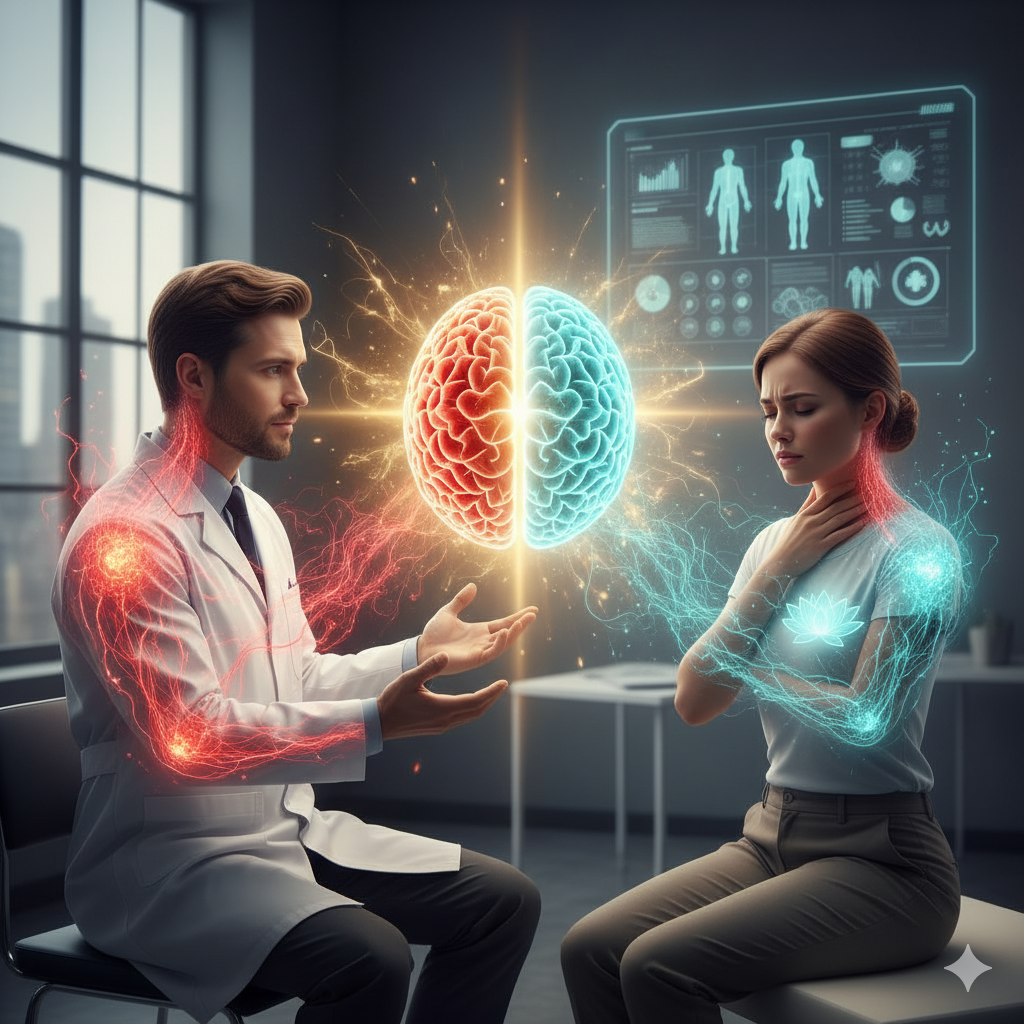
Inspiration: Episode #1: All Beginnings Are Difficult of the Mind Your Body podcast with Dr. Nevo.
I sneezed once and couldn’t move my neck for three days.
The whiplash from my car accident had already given me a herniated disc. But that sneeze taught me something the MRI scans never could: my body had learned to protect itself so aggressively that even the smallest movement triggered a cascade of pain and fear.
I’m a board-certified physician in physical medicine, rehabilitation, and regenerative medicine. I’ve treated thousands of patients with chronic pain. But I didn’t truly understand chronic pain until I lived it.
The anxiety came first. Then the depression. Then the creeping realization that the medical system I’d trained in for years had no real answers for what I was experiencing.
I’m not alone in this experience.
Chronic Pain Statistics: The Hidden Epidemic of Pain and Mental Health
24.3% of American adults live with chronic pain.[1] That’s roughly 51 million people. Another 8.5% experience high-impact chronic pain that frequently limits life or work activities.
But here’s what the statistics don’t capture: the devastating connection between chronic pain and mental health.
A 2025 meta-analysis of 376 studies across 50 countries found that approximately 40% of adults with chronic pain experience clinically significant depression and anxiety.[2] Nearly 4 out of 10 chronic pain patients battle dual conditions simultaneously.
The numbers get worse.
People with chronic pain represent only 20.4% of the U.S. adult population, yet they make up an estimated 55.5% of U.S. adults with clinically significant anxiety and depression symptoms.[2]
Adults living with chronic pain are approximately five times more likely to report untreated anxiety or depression symptoms compared to those without chronic pain. Even when mental health treatment is used, adults with chronic pain are more than twice as likely to experience continuing symptoms.[3]
This was my reality. The pain was real. The anxiety was real. The depression was real. And the medical system kept treating them as separate problems.
Why Traditional Pain Management Fails: The Problem with Fragmented Care
The Limitations of Conventional Pain Treatment
I tried everything. Physical therapy. Medications. Injections. Each specialist looked at one piece of the puzzle.
The orthopedist focused on my spine. The pain management doctor focused on my nerves. The psychiatrist focused on my mood. Nobody looked at me as a whole person.
This fragmented approach fails millions of patients every year.
Research on whiplash injuries reveals why my experience was so common. Studies show that 25% of whiplash victims develop herniated discs, and 39% experience cervical degeneration 5-10 years after the initial trauma.[4] One study found that 33% of whiplash patients showed disc herniations with nerve impingement over a 2-year follow-up period.[4]
But here’s what matters more: the tissue damage doesn’t fully explain the ongoing pain.
I’ve seen patients whose MRIs look terrible but who function beautifully. I’ve seen patients whose scans look normal but who can barely get out of bed. The disconnect between tissue damage and pain experience points to something deeper.
The Biopsychosocial Model: A Holistic Approach to Chronic Pain Treatment
Understanding Mind-Body Connection in Pain Management
The biopsychosocial model has been demonstrated to be the most effective approach to chronic pain assessment, prevention, and treatment.[5] It evaluates the integrated whole person with both mind and body as interconnected entities.
Research confirms that psychosocial variables such as depression, anxiety, and distress are among the most potent predictors of the transition from acute to chronic pain.[5]
This model recognizes what I learned through my own healing: your pain is 100% real, and your brain is 100% involved in creating and maintaining it.
When I finally found practitioners who understood this, everything changed. They didn’t dismiss my pain as psychological. They didn’t ignore my emotional state as irrelevant. They treated me as a complete human being whose nervous system had learned to protect me in ways that were now causing harm.
The problem? Despite evidence showing that comprehensive multidisciplinary management based on the biopsychosocial model is clinically effective and cost-efficient, it remains not widely available.[6]
Traditional medical approaches have failed to identify effective and long-lasting approaches for chronic pain management, often failing to consider the multiple domains that influence overall health.
Holistic Pain Relief: Evidence-Based Alternative Pain Management
Natural Pain Management Techniques That Work
A 2022 review of 15 studies found that alternative pain management approaches including massage, acupuncture, yoga, and physical therapy significantly reduced chronic pain without the adverse side effects that can come with frequent use of common pain medications.[7]
Interdisciplinary pain management programs have been shown to be highly effective in both management and cost-effectiveness.[6]
But effectiveness depends on more than just the treatments themselves.
I learned that healing requires three essential elements:
Safety. Your nervous system needs to feel safe before it can let go of protective pain patterns. This means addressing trauma, building trust with practitioners, and creating environments where you feel heard and validated.
Community. Isolation amplifies pain. Connection reduces it. Research on community and compassion shows that social support releases neurochemicals that directly impact pain perception.
Integration. Your body and mind work together. Treatments that address only one dimension miss the mark. You need approaches that recognize the bidirectional relationship between physical sensations and emotional states.
Building Your Integrated Pain Management Team
Mind Body Rehabilitation: An Integrative Approach to Healing Chronic Pain
I built Mind Body Rehabilitation because I needed it to exist when I was suffering. The ecosystem includes an interdisciplinary clinic, an online community, and a podcast. Each piece addresses a different aspect of healing.
The clinic provides comprehensive treatment that integrates physical interventions with psychological support. We use tools like the Safe and Sound Protocol, which employs sound frequencies to regulate the nervous system based on Polyvagal Theory developed by Dr. Stephen Porges.
The community offers connection and shared experience. When you’re in chronic pain, you often feel alone. You feel like nobody understands. Finding others who truly get it changes everything.
The podcast delivers education and psychoeducation. Understanding what’s happening in your body and brain gives you power. Knowledge transforms you from a passive victim into an active participant in your healing.
Chronic Pain Relief: Actionable Steps for Managing Pain and Mental Health
Essential Strategies for Pain Recovery
If you’re living with chronic pain, here’s what I want you to know:
Your pain is real. Full stop. Anyone who suggests otherwise doesn’t understand pain science.
Your brain is involved. This doesn’t make your pain less real. It means your nervous system has learned patterns that you can help it unlearn.
You need a team. Find practitioners who understand the biopsychosocial model. Look for people who treat you as a whole person, who listen to your story, and who partner with you rather than doing things to you.
Address your mental health. The connection between chronic pain and anxiety or depression is bidirectional. Treating one helps the other. This isn’t weakness. This is biology.
Build community. Find others who understand. Share your experience. Listen to theirs. The validation and connection matter more than you might think.
Give yourself time. Healing from chronic pain takes longer than healing from acute injury. Your nervous system learned these patterns over months or years. Unlearning them requires patience and persistence.
The Future of Chronic Pain Treatment: Accessible Holistic Care
We know what works. The biopsychosocial model is the gold standard. Interdisciplinary care is effective and cost-efficient. Holistic approaches reduce pain without harmful side effects.
The gap between what we know and what’s available to patients is unconscionable.
51 million Americans live with chronic pain. Millions more worldwide. Most receive fragmented care that addresses symptoms without understanding root causes. Most feel dismissed, misunderstood, and alone.
This has to change.
I transformed from a pain patient into a physician who specializes in integrated pain treatment because I saw the gap. I felt the gap. I lived in that gap for months while I searched for answers.
You deserve better than what the current system offers. You deserve practitioners who see you as a whole person. You deserve treatments that address both your body and your mind. You deserve a community that understands your experience.
The science supports this approach. The evidence validates it. The outcomes prove it works.
Now we need to make it accessible to everyone who needs it.
Your pain is real. Your healing is possible. And you don’t have to do it alone.
Take a moment: What would change in your healing journey if you believed your nervous system could learn new patterns?
About the Author
Dr. Zev Nevo is a double board-certified physiatrist, chronic pain survivor, and founder of the Body & Mind Pain Center. He helps people with persistent pain rebuild capacity and confidence using an evidence-based, trauma-informed mind-body rehabilitation approach.
Listen: Mind Your Body Podcast
Learn & Join: Mind-Body Rehabilitation Community
Visit the Clinic: Body & Mind Pain Center
Medical Disclaimer
The information in this article is for educational and informational purposes only and is not intended as a substitute for professional medical advice, diagnosis, or treatment. Always seek the advice of a qualified healthcare provider with any questions you may have regarding a medical condition. Never disregard professional medical advice or delay in seeking it because of something you have read in this article. New or changing pain symptoms should always be properly evaluated by a medical professional.
References
-
Yong RJ, Mullins PM, Bhattacharyya N. Prevalence of chronic pain among adults in the United States. JAMA Network Open. 2022;5(3):e2147684. https://www.cdc.gov/nchs/products/databriefs/db518.htm
-
Sheng J, Liu S, Wang Y, Cui R, Zhang X. The link between depression and chronic pain: neural mechanisms in the brain. Neural Plasticity. 2017;2017:9724371. Meta-analysis data from 376 studies across 50 countries. https://pmc.ncbi.nlm.nih.gov/articles/PMC11889470/
-
University of Arizona Health Sciences. Study shows millions of people live with co-occurring chronic pain and mental health symptoms. 2024. https://healthsciences.arizona.edu/news/releases/study-shows-millions-people-live-co-occuring-chronic-pain-and-mental-health-symptoms
-
Pettersson K, Hildingsson C, Toolanen G, Fagerlund M, Björnebrink J. Disc pathology after whiplash injury: a prospective magnetic resonance imaging and clinical investigation. Spine. 1997;22(3):283-287. https://pubmed.ncbi.nlm.nih.gov/9051890/
-
Gatchel RJ, Peng YB, Peters ML, Fuchs PN, Turk DC. The biopsychosocial approach to chronic pain: scientific advances and future directions. Psychological Bulletin. 2007;133(4):581-624. https://touchneurology.com/neuropathic-pain/journal-articles/the-biopsychosocial-model-of-the-assessment-prevention-and-treatment-of-chronic-pain/
-
Scascighini L, Toma V, Dober-Spielmann S, Sprott H. Multidisciplinary treatment for chronic pain: a systematic review of interventions and outcomes. Rheumatology. 2008;47(5):670-678. https://pubmed.ncbi.nlm.nih.gov/26172982/
-
Hinge Health. Holistic pain relief: alternative pain management approaches. 2022. Review of 15 studies on alternative pain management. https://www.hingehealth.com/resources/articles/holistic-pain-relief/