 Mind Your Body Podcast
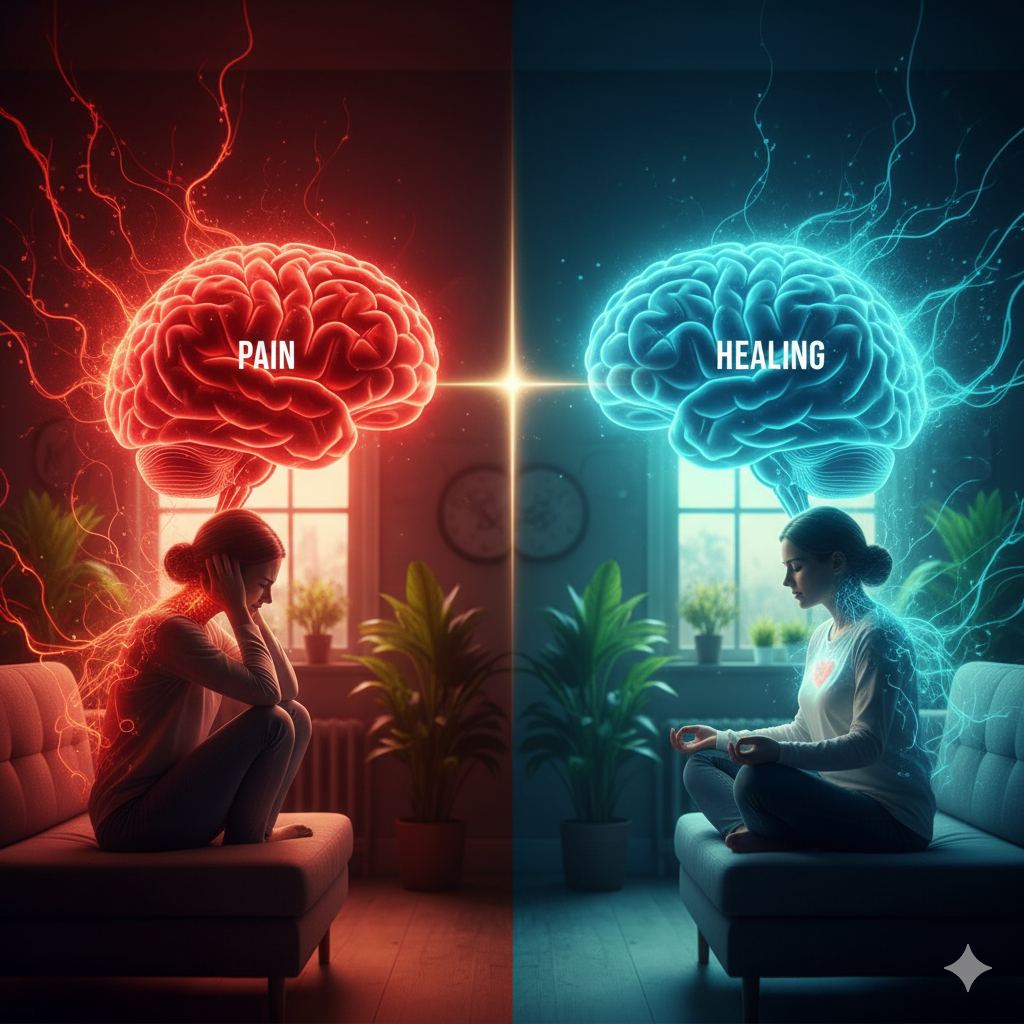
Inspiration: Episode 3: The Pain Experience – Part I of the Mind Your Body podcast with Dr. Nevo.
Understanding the neuroscience of pain perception and how cognitive reappraisal can reduce suffering without eliminating sensation.
I spend my days helping people understand something that sounds impossible: two people with identical injuries can experience completely different levels of pain.
Not because one person is stronger or tougher.
Because pain isn’t what most of us think it is.
Pain Is an Interpretation, Not a Measurement
About 10% of your entire nervous system is dedicated to sensing pain.[1] But these signals don’t travel straight to your conscious awareness. They pass through your spinal cord, where your body can amplify or dampen them before they ever reach your brain.[2]
Think of it like a dimmer switch rather than an on/off button.
Your brain then takes these modified signals and runs them through a sophisticated threat appraisal system. It asks: How dangerous is this? What does this mean based on everything I’ve experienced before? What emotional state am I in right now?
The answers to these questions determine your pain experience.
This explains why the same stubbed toe hurts more when you’re stressed about a work deadline than when you’re relaxed on vacation. The tissue damage is identical. The interpretation is completely different.[3]
The Emotional Component Isn’t Secondary. It’s Fundamental.
Research shows that anger and frustration are critical concomitants of the pain experience.[4] After controlling for pain intensity, these emotions predict pain unpleasantness. When people report greater anger than their baseline, their inflammation levels rise.[5]
Your brain cannot differentiate between emotional stress and physical stress.
Stress increases cortisol and adrenaline, which heighten sensitivity to pain by increasing inflammation and affecting how your nervous system functions.[6] Anxiety creates hyperawareness of bodily sensations, amplifying pain perception and creating a vicious cycle.[7]
This isn’t weakness. This is biology.
Your nervous system evolved to prioritize survival above everything else. When you’re emotionally dysregulated, your brain interprets the world as more threatening. It turns up the volume on pain signals because pain is your body’s primary warning system.
Why Understanding This Changes Everything
You can have tissue damage without pain. You can have pain without tissue injury.[8]
The brain is the CEO. The nerves are its messengers.
Pain is influenced by its threat value. The more threatening your brain perceives a sensation to be, the more attention it assigns to that sensation, which modulates your pain perception. This prioritization is an innate response designed to keep you safe.[9]
But here’s what most people don’t realize: learning how pain works reduces the severity and functional limitations of pain. This knowledge alone becomes therapeutic.[10]
Sometimes understanding the mechanism is more important than treating the painful body part itself, especially when there are no significant tissue issues.
The Two Parts of Pain You Can Influence
Pain has two distinct components: what you physically feel and your emotional response to that feeling.
The physical sensation travels through nerve pathways. The emotional response involves how your brain interprets that sensation based on context, past experiences, current stress levels, and what the pain means to you.
You have limited control over the first component in the moment. But you have significant influence over the second.
This is where reframing becomes powerful.
Reframing Isn’t Positive Thinking. It’s Reappraisal.
Cognitive reappraisal works remarkably fast. Studies show it can diminish activity in pain-processing brain regions from as early as 100 milliseconds. It affects the anterior cingulate cortex, orbitofrontal cortex, anterior temporal region, and insula.[11]
Both cognitive reappraisal and distraction decrease pain unpleasantness regardless of pain intensity. When people think about the informational value of pain rather than the negatives, they report significantly less unpleasantness, even though pain intensity remains the same.[12]
The sensation doesn’t disappear. The suffering decreases.
Reframing gives pain a purpose: it’s a protective mechanism, not a punishment. It’s information, not a life sentence. This shift moves you from victimhood to agency.
How to Actually Reframe Pain
Start by acknowledging the pain is real. Your nervous system isn’t lying to you. It’s trying to protect you based on the information it has.
Then ask different questions:
Instead of “Why is this happening to me?”
Ask: “What is my nervous system trying to tell me?”
Instead of “This will never get better”
Recognize: “My brain can learn new patterns. Neuroplasticity is real.”
Instead of “I can’t do anything because of this pain”
Consider: “What can I do today, even with this sensation present?”
This isn’t about denying your experience. It’s about creating space for your logical brain to assess actual threat instead of being governed by past pain experiences.
The Nervous System Needs Safety First
You cannot reframe your way out of a dysregulated nervous system. Safety comes before exposure.
When your nervous system is in a threat state, it amplifies pain signals. No amount of cognitive work will override a system that believes it’s under attack.
This is why approaches like polyvagal-informed strategies, breathwork, and movement matter. They signal safety to your nervous system at a level below conscious thought.[13]
Once your system feels safer, reframing becomes possible. Your brain can actually hear the new interpretation instead of being drowned out by alarm signals.
The Practical Application
I work with people who have tried everything. Physical therapy, injections, surgery, medications. Some of these interventions help. Many don’t address the full picture.
The most effective approach integrates both: addressing tissue health when needed while simultaneously retraining how the nervous system interprets signals.
This means:
Validating the pain without reinforcing threat
Building nervous system capacity through regulation techniques
Gradually expanding what feels safe to your body
Reframing sensations from danger to information
Focusing on function over pain scores
The goal isn’t to eliminate all pain. The goal is to change your relationship with it so pain no longer controls your life.
What This Means for Your Recovery
If you’ve been told your pain is “all in your head,” that’s both wrong and right.
Wrong because the pain is 100% real. Your nervous system is generating real signals.[14]
Right because your brain is actively constructing your pain experience from multiple inputs, and you can influence that construction.
The variability in pain ratings among patients with the same disease or trauma is enormous. This isn’t about pain tolerance or mental toughness. It’s about biological factors, psychological factors, and social factors all converging.[15]
Understanding this removes shame. It opens possibilities.
Your brain can change. Your nervous system can learn. The patterns that amplify your pain can be interrupted and replaced with patterns that modulate it.[16]
This takes time. It requires patience with yourself. It demands that you approach your pain with curiosity rather than fear.
But it works.
The Path Forward
Start where you are. Not where you think you should be.
💡 Your First Step This Week
Choose one moment of pain or discomfort this week and pause. Instead of immediately reacting, ask yourself: “What is my nervous system trying to tell me right now?” Notice what emotions are present alongside the physical sensation. Write down what you discover. This simple act of curious observation begins to shift your relationship with pain from fear to understanding.
Notice when your pain increases. What else is happening? Are you stressed? Angry? Afraid? Exhausted? These aren’t separate from your pain. They’re part of the system generating it.
Practice small moments of nervous system regulation. A few deep breaths. A short walk. Listening to calming music. These aren’t distractions. They’re signals to your brain that you’re safe enough to turn down the alarm.
Reframe one thought at a time. You don’t need to believe it completely. Just create a small opening for a different interpretation.
Work with practitioners who understand both tissue health and nervous system function. The best outcomes come from addressing the whole system, not just one part.
Your pain is real. Your suffering can change. These two truths can coexist.
The brain that learned to amplify pain can learn to modulate it. You’re not broken. You’re experiencing exactly what a nervous system does when it believes it needs to protect you.
Now you can teach it something different.
About the Author
Dr. Zev Nevo is a double board-certified physiatrist, chronic pain survivor, and founder of the Body & Mind Pain Center. He helps people with persistent pain rebuild capacity and confidence using an evidence-based, trauma-informed mind-body rehabilitation approach.
Listen: Mind Your Body Podcast
Learn & Join: Mind-Body Rehabilitation Community
Visit the Clinic: Body & Mind Pain Center
Medical Disclaimer
The information in this article is for educational and informational purposes only and is not intended as a substitute for professional medical advice, diagnosis, or treatment. Always seek the advice of a qualified healthcare provider with any questions you may have regarding a medical condition. Never disregard professional medical advice or delay in seeking it because of something you have read in this article. New or changing pain symptoms should always be properly evaluated by a medical professional.
References
-
Basbaum, A. I., Bautista, D. M., Scherrer, G., & Julius, D. (2009). Cellular and molecular mechanisms of pain. Cell, 139(2), 267-284. https://doi.org/10.1016/j.cell.2009.09.028
-
Melzack, R., & Wall, P. D. (1965). Pain mechanisms: A new theory. Science, 150(3699), 971-979. https://doi.org/10.1126/science.150.3699.971
-
Bushnell, M. C., Čeko, M., & Low, L. A. (2013). Cognitive and emotional control of pain and its disruption in chronic pain. Nature Reviews Neuroscience, 14(7), 502-511. https://doi.org/10.1038/nrn3516
-
Greenwood, K. A., Thurston, R., Rumble, M., Waters, S. J., & Keefe, F. J. (2003). Anger and persistent pain: Current status and future directions. Pain, 103(1-2), 1-5. https://doi.org/10.1016/s0304-3959(02)00316-7
-
Graham, J. E., Robles, T. F., Kiecolt-Glaser, J. K., Malarkey, W. B., Bissell, M. G., & Glaser, R. (2006). Hostility and pain are related to inflammation in older adults. Brain, Behavior, and Immunity, 20(4), 389-400. https://doi.org/10.1016/j.bbi.2005.11.002
-
Hannibal, K. E., & Bishop, M. D. (2014). Chronic stress, cortisol dysfunction, and pain: A psychoneuroendocrine rationale for stress management in pain rehabilitation. Physical Therapy, 94(12), 1816-1825. https://doi.org/10.2522/ptj.20130597
-
Asmundson, G. J., & Katz, J. (2009). Understanding the co-occurrence of anxiety disorders and chronic pain: State-of-the-art. Depression and Anxiety, 26(10), 888-901. https://doi.org/10.1002/da.20600
-
Moseley, G. L. (2007). Reconceptualising pain according to modern pain science. Physical Therapy Reviews, 12(3), 169-178. https://doi.org/10.1179/108331907X223010
-
Legrain, V., Iannetti, G. D., Plaghki, L., & Mouraux, A. (2011). The pain matrix reloaded: A salience detection system for the body. Progress in Neurobiology, 93(1), 111-124. https://doi.org/10.1016/j.pneurobio.2010.10.005
-
Louw, A., Zimney, K., Puentedura, E. J., & Diener, I. (2016). The efficacy of pain neuroscience education on musculoskeletal pain: A systematic review of the literature. Physiotherapy Theory and Practice, 32(5), 332-355. https://doi.org/10.1080/09593985.2016.1194646
-
Lapate, R. C., Lee, H., Salomons, T. V., van Reekum, C. M., Greischar, L. L., & Davidson, R. J. (2012). Amygdalar function reflects common individual differences in emotion and pain regulation success. Journal of Cognitive Neuroscience, 24(1), 148-158. https://doi.org/10.1162/jocn_a_00125
-
Denson, T. F., Creswell, J. D., Terides, M. D., & Blundell, K. (2014). Cognitive reappraisal increases neuroendocrine reactivity to acute social stress and physical pain. Psychoneuroendocrinology, 49, 69-78. https://doi.org/10.1016/j.psyneuen.2014.07.003
-
Porges, S. W. (2011). The polyvagal theory: Neurophysiological foundations of emotions, attachment, communication, and self-regulation. W. W. Norton & Company.
-
Apkarian, A. V., Bushnell, M. C., Treede, R. D., & Zubieta, J. K. (2005). Human brain mechanisms of pain perception and regulation in health and disease. European Journal of Pain, 9(4), 463-484. https://doi.org/10.1016/j.ejpain.2004.11.001
-
Edwards, R. R., Dworkin, R. H., Sullivan, M. D., Turk, D. C., & Wasan, A. D. (2016). The role of psychosocial processes in the development and maintenance of chronic pain. The Journal of Pain, 17(9), T70-T92. https://doi.org/10.1016/j.jpain.2016.01.001
-
Flor, H. (2012). New developments in the understanding and management of persistent pain. Current Opinion in Psychiatry, 25(2), 109-113. https://doi.org/10.1097/YCO.0b013e3283503510