 Mind Your Body Podcast
TL;DR: Chronic pain isn’t just a structural problem. Your brain learns pain through repetition and can unlearn it through targeted mindset and nervous system work. This article explains the neuroscience, gives you a checklist to screen for neuroplastic pain, and walks you through the mental shifts that reduce suffering, even when the pain itself persists.
-
Neuroplastic pain is real pain generated by your nervous system, not ongoing tissue damage.
-
Your brain’s emotional circuitry, not just physical injury, determines whether acute pain becomes chronic.
-
Accurate threat appraisal (not toxic positivity) is the core skill for reducing suffering.
-
Pain reprocessing approaches reduced chronic back pain in 66% of patients in a clinical trial.
-
The keystone shift: you are more than your body. Pain doesn’t define you.
After years treating chronic pain through both conventional and integrative approaches, I’ve watched something shift in my patients, not when we fixed their bodies, but when we changed how their brains interpreted the signals.
Let me show you what that actually looks like.
You wake up at 4am tasting doughnuts.
You haven’t eaten anything. You were asleep. But the taste is unmistakable, vivid, wrong.
That sensation would be pleasurable while eating a doughnut. But in the wrong context, it’s frightening. Your brain scrambles to make sense of a signal that doesn’t match reality.
This is exactly what happens with chronic pain. Same neural machinery. Different context.
The sensation is real. The threat assessment is broken.
The Lie We’ve Been Told About Chronic Pain
We’ve been taught that chronic pain means something in your body is damaged and needs fixing. Find the right doctor, the right treatment, the right injection, and the pain stops.
And when it doesn’t stop, the message you absorb, often unspoken, is that you’re not trying hard enough.
Or worse: that you’re somehow choosing to suffer.
Here’s what’s actually happening.
Your nervous system learns pain the same way it learns anything else. Through repetition. Through association. Through context.
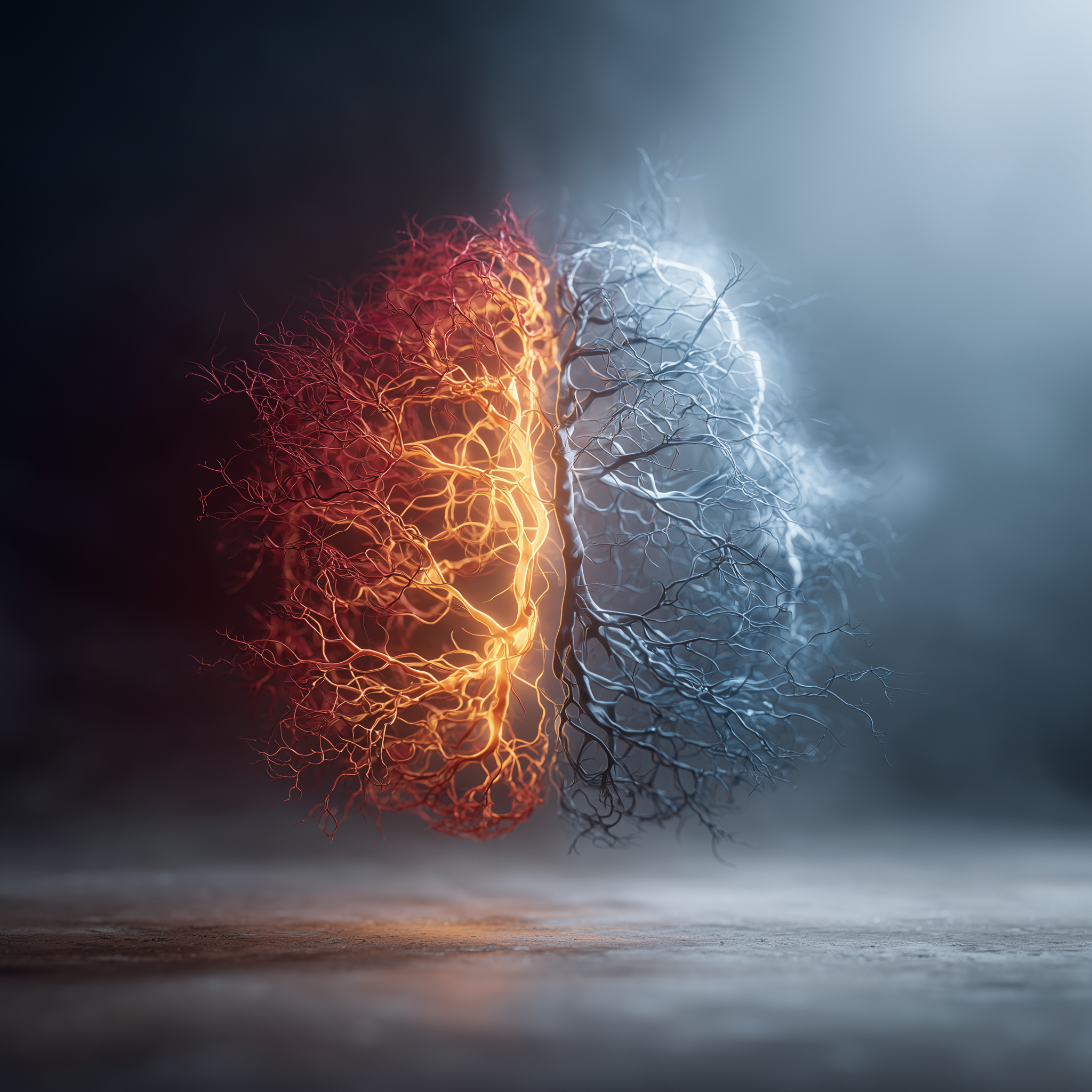
After months or years of pain signals, your brain becomes hypersensitive. It starts firing threat alarms even when there’s no active tissue damage. Your prefrontal cortex, which normally regulates these signals, gets overridden by a limbic system stuck in survival mode.
The pain is 100% real. And your brain is amplifying it.
This is neuroplastic pain: pain generated by your nervous system in the absence of ongoing tissue damage.
And here’s the part that changes everything: if your brain learned it, your brain can unlearn it.
Research in Frontiers in Neuroscience confirms that neuroplasticity works in both directions. If the brain learned pain through maladaptive changes, it can unlearn it through targeted interventions that reverse those pain states.
Why “Just Think Positive” Gets It So Wrong
If you’re living with chronic pain, you’ve probably heard “just change your mindset” more times than you want to count.
When someone with chronic pain hears “mindset matters,” what they often hear is dismissal.
They hear: your suffering isn’t real. You’re not trying hard enough. Be more positive.
That’s toxic positivity. And it misses the point entirely.
You deserve more than being told to “think positive” while your body is screaming.
What actually works is something different: accurate threat appraisal.
It’s not about ignoring or minimizing pain. It’s about pausing to investigate whether the alarm your nervous system is sounding actually matches the current threat level.
This means asking: Was there a recent trigger, physical or emotional? Are you already fatigued or stressed, which amplifies pain perception? Is underlying fear or frustration intensifying the signal?
A comprehensive review of the literature shows that exposure to stress or adversity, such as trauma, childhood difficulties, or job dissatisfaction, predicts chronic symptoms better than any physical measure.
Are you anticipating pain before a movement that used to hurt, causing your brain to generate the sensation before the trigger even happens?
Every sensation can be positive, neutral, or negative depending on context.
That doughnut taste at 4am? Terrifying. Same taste while eating breakfast? Delicious.
Your lower back pain when bending? Your brain might be protecting you from a threat that no longer exists.
The goal here is recognition and allowance: acknowledging pain’s presence, understanding its protective role, then asking whether its current messaging matches present reality.
This reduces emotional reactivity and suffering, even while you’re physically experiencing pain sensations.
You’re not pretending pain away. You’re investigating whether the alarm matches the actual threat.
“Your pain is real. Your brain’s interpretation might not be.”
🔑 Key Takeaways So Far
-
Neuroplastic pain is real pain generated by your nervous system, not ongoing tissue damage
-
Your brain learned pain through repetition and can unlearn it the same way
-
Accurate threat appraisal means investigating whether the alarm matches the actual danger
-
Context changes everything – the same sensation can be pleasant or terrifying depending on the situation
The Detective Work Your Nervous System Actually Needs
When chronic pain is entrenched, your nervous system is stuck in survival mode. That’s not a character flaw. It’s a learned pattern.
But here’s what most people miss: you can capture and savor moments when your pain is less intense, even briefly.
You probably think those moments don’t exist for you. They do.
Your brain tags negative memories with more emotional weight because that’s how it keeps you alive. But when you’re deeply engaged, absorbed, or joyful, pain often recedes into the background.
You’re not imagining this. It’s neuroscience.
This isn’t judgment. It’s observation. And it’s neuroscience.
I work with people carrying decades of pain. They’re not broken. They’re stuck.
Creating mental snapshots of moments with even slightly less intense pain helps cool off your nervous system. Think of it like an insurance policy. It doesn’t prevent catastrophe, but knowing you have resources changes how you carry the weight of uncertainty.
The neuroscience is precise: mindfulness, breathwork, and somatic approaches activate your medial prefrontal cortex, which counters your limbic system’s grip on pain-related thoughts, emotions, and behaviors.
Research published in Frontiers in Psychology shows that pain reappraisal can reduce activity in the limbic brain regions in as little as 100 milliseconds. That’s before you’re even consciously aware.
When pain is extreme, though, this approach shifts.
You don’t attack pain directly with your thoughts when it’s at a 9 out of 10. You practice self-compassion. You acknowledge its temporary nature. You work to bring intensity down to a more manageable level.
Then, from there, you can begin implementing neural exercises to widen your window of tolerance.
When pain is severe, the goal is to move from negative to neutral. Not negative to positive. That’s the honest version of this work.
Meeting yourself where you are isn’t giving up. It’s wisdom.
The Checklist That Helps You Read Your Own Pain
How do you know if your pain is neuroplastic versus structural?
You investigate, systematically.
Did your pain begin during or shortly after a period of high stress, adversity, or trauma? Did it start without a clear physical injury? Has it persisted long after an initial injury should have healed?
Is your pain inconsistent, with good days and bad days that don’t have a clear physical cause? Does it move around, spread to new areas, or switch sides? Does it appear in non-anatomical patterns?
Does your pain sometimes disappear when you’re deeply engaged or joyful? Is it triggered by anticipation of stress, or simply by imagining certain movements?
Do you have a history of anxiety, depression, or past trauma? Would you describe yourself as a perfectionist, a people-pleaser, or someone who’s highly self-critical?
Going through these questions creates a temporal pause. That pause activates your prefrontal cortex and opens communication with your somatosensory cortex.
The pause itself is part of the treatment.
When you recognize that your pain has neuroplastic features, something visceral shifts. You build buy-in for pain reappraisal strategies. You stop fighting the wrong battle.
Here’s what makes this powerful:
Your MRI doesn’t tell the whole story.
It might not even be telling you the most important part.
Here’s why: 64% of people with no back pain have disk abnormalities on MRI. By age 60, 90% show disk degeneration.
These are normal changes, like gray hair or wrinkles. They don’t necessarily cause pain.
Translation: Most “abnormalities” on your scan are just your body aging normally.
Structural changes on imaging don’t create the same experience in different people. Your brain’s interpretation matters more than the scan.
98% of participants in the Pain Reprocessing Therapy study showed at least some improvement.
In one groundbreaking study, 66% of people with chronic back pain became pain-free or nearly pain-free after Pain Reprocessing Therapy. The average duration of their pain? Ten years.
Compare that to 20% in the placebo group and 10% in usual care.
These weren’t people with minor discomfort. These were people who’d tried everything and failed.
What changed wasn’t their spines. What changed was their brains’ interpretation of the signals.
A study in Nature Neuroscience found that functional connectivity between the nucleus accumbens and medial prefrontal cortex accurately predicts who develops chronic pain. It’s your emotional brain circuitry, not just tissue damage, that determines whether acute pain becomes chronic.
“What changed wasn’t their spines. What changed was their brains’ interpretation of the signals.”
When You’re Doing Everything Right and Still Hurting
You’ve done the checklist. You’re practicing the strategies. You understand the neuroscience.
And you’re still in significant pain.
You’re not failing. You’re in process.
Now what?
Early in this work, pain often persists or even worsens. This is called an extinction burst. It’s normal and expected.
This is your nervous system testing whether you really mean it.
Building neural pathways takes time. You’re creating new networks and pruning old ones. That requires at least six weeks of daily repetition.
Research on chronic pain and neuroplasticity shows that continued suffering is critically dependent on the state of motivational and emotional mesolimbic-prefrontal circuitry. This means your emotional brain state directly influences pain persistence.
Life stressors cause flare-ups. That’s not failure. That’s being human.
The goal is building enough internal resources that adversity, when it comes, doesn’t push you into a maladaptive survival state that amplifies your suffering.
Think about a 70-year-old woman with collapsed vertebrae who has found a way to maintain happiness despite real, persistent pain.
She’s not cured. The structural damage is real. But she’s not stuck in survival mode.
What sets her apart?
She’s found openings for mindful living, joy, creativity, connection, and contentment alongside pain, not instead of it.
She’s stopped asking “why me?” She’s stopped living in resentment and comparison.
She explores the protective message behind her pain while channeling energy into meaning and purpose.
She’s not a pain person. She’s a person in pain.
That distinction is everything.
You are not your pain. You are a whole person who happens to be experiencing pain.
The Identity Shift That Unlocks Everything Else

When pain colonizes your identity, it consumes everything: every thought, every plan, every relationship.
You become “the person in pain.” Work, relationships, daily activities all get reorganized around managing or avoiding your condition.
The first step in reconstruction: re-explore what brings you authentic meaning and purpose, separate from pain.
Service to others. Creativity. Connection. Time spent on things that aren’t about relieving pain.
Studies on cognitive reappraisal show it serves as a protective factor against pain’s negative effects on wellbeing, with high levels of cognitive reappraisal buffering against the impact of severe pain on emotional health.
You shift from identifying as a pain person to recognizing yourself as a person who is experiencing pain.
Pain becomes something you have, not something you are.
That shift opens space for the rest of your life to exist again.
The One Shift That Makes Everything Else Work
If I had to name the single realization that unlocks everything else, it’s this.
You are more than your body.
Our pain doesn’t define us.
There’s a lot you can’t control. And the less energy you spend fighting the need for certainty and control, the better you’ll tolerate all forms of adversity: stress, pain, and trauma.
Nothing is guaranteed. Not health, not comfort, not a pain-free morning.
Gratitude, real gratitude, comes from recognizing how much worse things could be, and appreciating what remains, rather than measuring your life against an ideal that doesn’t exist.
Experiencing pain is part of the human experience. It helps us recognize subtle moments of peace and serenity that we’d otherwise walk right past.
This challenges a deep cultural assumption: that we should be able to control our bodies, that a pain-free existence is the default we’re owed.
Pain serves a purpose. When you understand it that way, your body isn’t failing you when you feel pain. It’s communicating a message of survival.
What we do with that messaging is up to us.
Once that’s internalized, emotional suffering decreases first. Then pain intensity begins to shift. Then you stop organizing every thought and action around the context of your pain.
Daily functioning and quality of life improve.
Pain creates resilient people. There’s less fragility. More post-traumatic growth.
Research on tension myositis syndrome showed that patients treated with a mind-body program experienced a 52% decrease in average pain, 35% decrease in worst pain, and 65% decrease in least pain. The pain was real. The treatment addressed the brain’s role in generating it.
Pain is rooted in a desire to live. It’s your nervous system saying: I’m still here. I still care.
According to research in the International Journal of Molecular Sciences, pain chronification involves a transition from sensory regions to emotional and limbic regions of the brain. When you address the emotional circuitry, you’re working with the actual mechanism of chronic pain.
“Pain is rooted in a desire to live. Your body isn’t failing you. It’s trying to protect you.”
What Actually Shifts First
When someone truly accepts this perspective, emotional suffering decreases first.
The constant mental battle softens. The “why me?” fades. The resentment loosens.
Then pain intensity begins to shift. Not always dramatically. Not always immediately. But measurably.
Finally, daily functioning improves. You stop organizing your entire life around pain management.
You become a person who happens to have pain, living a life that contains many other things.
Your brain learned pain through repetition, association, and context.
And what your brain learned, it can unlearn.
It can unlearn it the same way.
Through accurate threat appraisal. Through mental snapshots of relief. Through prefrontal cortex activation that regulates your limbic alarm system.
Through understanding that structural changes on imaging don’t determine your experience of pain.
Through shifting from pain person to person in pain.
Through recognizing that you are more than your body. That pain doesn’t define you. That resilience isn’t about controlling everything; it’s about tolerating uncertainty.
The pain is real. The suffering is negotiable.
Your brain is listening. What will you teach it next?
Your Action Steps This Week
Day 1-2: The Awareness Phase
-
Notice one moment when your pain is slightly less intense. Just notice. Don’t judge.
-
Take a mental snapshot: What were you doing? Who were you with? What were you thinking about?
Day 3-4: The Investigation Phase
-
Review the neuroplastic pain checklist in this article
-
Answer honestly. This isn’t about getting a “good” score. It’s about understanding.
-
Notice which questions make you pause. That’s where the insight lives.
Day 5-7: The Practice Phase
-
When pain flares, pause for 30 seconds before reacting
-
Ask: “What was happening right before this? Am I stressed? Anxious? Anticipating pain?”
-
Practice one grounding technique: 5 deep breaths, naming 5 things you can see, or placing your hand on your heart
Remember: You’re building neural muscles. Six weeks of daily practice creates measurable change. You’re not behind. You’re exactly where you need to be.
Quick Summary: What to Remember
The Science:
-
Chronic pain involves neuroplasticity – your brain learning and amplifying pain signals
-
66% of people with 10-year chronic pain became pain-free with Pain Reprocessing Therapy
-
64% of people with no back pain show disk abnormalities on MRI
-
Your emotional brain circuitry predicts chronic pain better than physical measures
-
Pain reappraisal reduces limbic activity in as little as 100 milliseconds
The Shift:
-
From pain person → person in pain
-
From “why me?” → “what can I learn from this?”
-
From fighting pain → understanding its protective message
-
From isolation → connection and meaning
-
From negative to neutral when positive isn’t accessible
The Truth:
-
Your pain is 100% real
-
Your brain’s threat assessment might be outdated
-
Emotional suffering can decrease before pain intensity
-
You are more than your body
-
Resilience isn’t about control – it’s about tolerance for uncertainty
Join the Conversation
You’re not alone in this. Thousands of people are learning to transform their relationship with chronic pain.

Share your experience:
-
What resonated most with you in this article?
-
Have you noticed moments when your pain decreases during deep engagement?
-
What’s one small step you’re committing to this week?
Your story might be exactly what someone else needs to hear today. Share this article with someone who needs hope.
Quotable Wisdom
“Your pain is real. Your brain’s interpretation might not be.”
“You’re not a pain person. You’re a person in pain.”
“What your brain learned, it can unlearn.”
“The pain is real. The suffering is negotiable.”
“Meeting yourself where you are isn’t giving up. It’s wisdom.”
Frequently Asked Questions
Is neuroplastic pain the same as “it’s all in your head”?
No. Neuroplastic pain is physically real. It’s generated by your nervous system, which produces genuine pain signals. The distinction is that the source is a sensitized nervous system, not active tissue damage. Your pain is not imagined.
How long does it take to see results from pain reprocessing approaches?
Research suggests at least six weeks of daily practice to begin building new neural pathways. Results aren’t linear. Pain may temporarily worsen before it improves, which is a normal part of the nervous system recalibrating.
Can someone with real structural damage (like collapsed vertebrae or disk degeneration) still benefit from these approaches?
Yes. Structural damage and neuroplastic pain often coexist. The ratio shifts over time. Addressing the nervous system’s amplification of signals doesn’t require the structural issue to be resolved first.
What’s the difference between accurate threat appraisal and toxic positivity?
Toxic positivity dismisses or minimizes pain. Accurate threat appraisal acknowledges the pain fully while asking whether the nervous system’s alarm level matches the actual current threat. It’s investigative, not dismissive.
What is an extinction burst and why does pain worsen before it gets better?
An extinction burst is your nervous system’s temporary escalation of a learned behavior when it’s being retrained. It’s a sign the old pattern is being challenged, not evidence that the approach isn’t working.
How do I know if my pain is neuroplastic or structural?
Use the checklist in this article. Key signs of neuroplastic pain include onset during high stress, inconsistent pain patterns, pain that moves around or switches sides, pain triggered by anticipation or emotion, and pain that eases during deep engagement or joy.
What does “person in pain” vs. “pain person” actually mean in daily life?
A “pain person” organizes their entire identity and daily life around the condition. A “person in pain” acknowledges the pain while maintaining other roles, relationships, and sources of meaning. The shift is subtle but neurologically significant.
Is mindset work a replacement for medical treatment?
No. Mind-body approaches work alongside medical treatment, not instead of it. Structural pain requires structural assessment. The goal is accurate appraisal: addressing both the physical and the neurological components of your experience.
Key Takeaways
-
Your pain is 100% real. Your nervous system’s threat assessment may be outdated.
-
Neuroplastic pain is generated by a sensitized nervous system, not ongoing tissue damage, and it responds to targeted nervous system work.
-
Accurate threat appraisal means investigating whether the alarm matches the actual danger, not pretending the pain away.
-
66% of people with decade-long chronic back pain became pain-free or nearly pain-free with Pain Reprocessing Therapy.
-
Mental snapshots of low-pain moments, breathwork, and somatic approaches activate the prefrontal cortex and counter limbic dominance.
-
When pain is severe, the goal is neutral, not positive. Meeting yourself where you are is wisdom, not weakness.
-
The keystone shift: you are more than your body. Pain is something you experience. It’s not who you are.
About the Author
Dr. Zev Nevo is a double board-certified physiatrist, chronic pain survivor, and founder of the Body & Mind Pain Center. He works with people in persistent pain to rebuild capacity and confidence using an evidence-based, trauma-informed mind-body rehabilitation approach.
Listen: Mind Your Body Podcast
Learn & Join: Mind-Body Rehabilitation Community
Visit the Clinic: Body & Mind Pain Center
Medical Disclaimer
The information in this article is for educational and informational purposes only and is not intended as a substitute for professional medical advice, diagnosis, or treatment. Always seek the advice of a qualified healthcare provider with any questions you may have regarding a medical condition. Never disregard professional medical advice or delay in seeking it because of something you have read in this article. New or changing pain symptoms should always be properly evaluated by a medical professional.
References & Further Reading
-
Lorenz, J., Minoshima, S., & Casey, K. L. (2003). Keeping pain out of mind: the role of the dorsolateral prefrontal cortex in pain modulation. Brain, 126(5), 1079-1091. https://academic.oup.com/brain/article/126/5/1079/489233
-
Ashar, Y. K., Gordon, A., Schubiner, H., et al. (2021). Effect of Pain Reprocessing Therapy vs Placebo and Usual Care for Patients With Chronic Back Pain: A Randomized Clinical Trial. JAMA Psychiatry, 79(1), 13-23. https://jamanetwork.com/journals/jamapsychiatry/fullarticle/2784694
-
Baliki, M. N., Petre, B., Torbey, S., et al. (2012). Corticostriatal functional connectivity predicts transition to chronic back pain. Nature Neuroscience, 15(8), 1117-1119. https://pmc.ncbi.nlm.nih.gov/articles/PMC4924545/
-
Kross, E., Berman, M. G., Mischel, W., Smith, E. E., & Wager, T. D. (2011). Social rejection shares somatosensory representations with physical pain. Proceedings of the National Academy of Sciences, 108(15), 6270-6275. https://pmc.ncbi.nlm.nih.gov/articles/PMC7105446/
-
Apkarian, A. V., Baliki, M. N., & Geha, P. Y. (2009). Towards a theory of chronic pain. Progress in Neurobiology, 87(2), 81-97. Referenced in Washington Post analysis. https://www.washingtonpost.com/outlook/2021/10/15/chronic-pain-brain-plasticity/
-
Sheng, J., Liu, S., Wang, Y., Cui, R., & Zhang, X. (2017). The Link between Depression and Chronic Pain: Neural Mechanisms in the Brain. Neural Plasticity, 2017, 9724371. https://pmc.ncbi.nlm.nih.gov/articles/PMC11965994/
-
Bushnell, M. C., Čeko, M., & Low, L. A. (2013). Cognitive and emotional control of pain and its disruption in chronic pain. Nature Reviews Neuroscience, 14(7), 502-511. https://www.mdpi.com/1422-0067/20/13/3130
-
Lumley, M. A., Cohen, J. L., Borszcz, G. S., et al. (2011). Pain and emotion: a biopsychosocial review of recent research. Journal of Clinical Psychology, 67(9), 942-968. https://pubmed.ncbi.nlm.nih.gov/17900039/
-
Salomons, T. V., Moayedi, M., Erpelding, N., & Davis, K. D. (2014). A brief cognitive-behavioural intervention for pain reduces secondary hyperalgesia. Pain, 155(8), 1446-1452. https://www.frontiersin.org/journals/psychology/articles/10.3389/fpsyg.2024.1467555/full
-
Moseley, G. L., & Butler, D. S. (2015). Fifteen Years of Explaining Pain: The Past, Present, and Future. Journal of Pain, 16(9), 807-813. https://pmc.ncbi.nlm.nih.gov/articles/PMC11585895/